
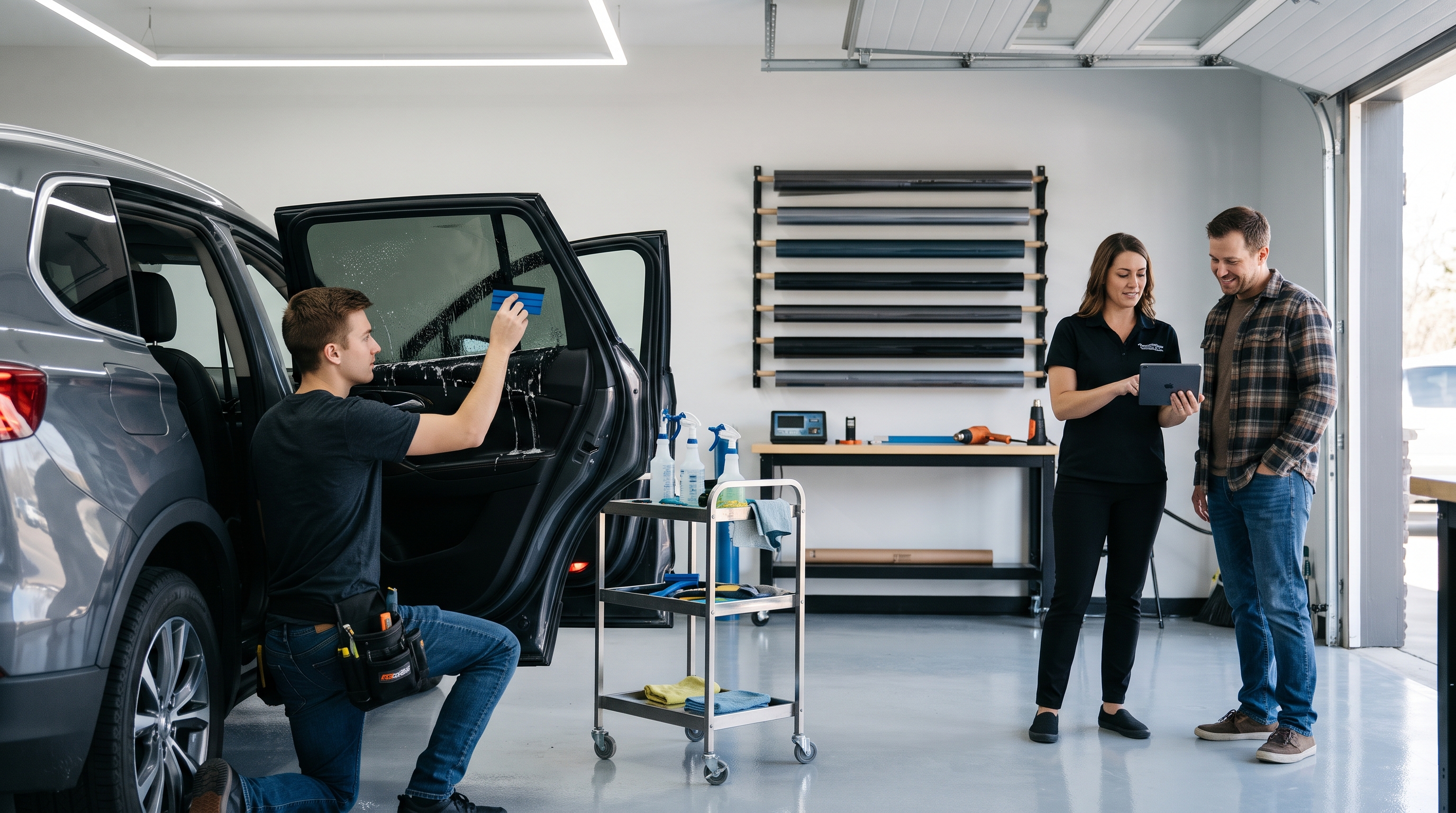
How to start a window tinting business: the short answer
You can start a window tinting business for about $2,000 to $5,000 if you work mobile or out of a home garage and cut film by hand. A rented shop with a plotter and a van pushes the budget to $15,000 or more. Most of the early money goes to training and film, not tools.
The order that works for most new tinters:
- Practice first: Learn to install on scrap glass and your own car before you charge anyone.
- Choose a business model: Decide between mobile, rented bay, or franchise.
- Handle legal & insurance: Register the business, get a seller's permit, and buy insurance that covers customer cars.
- Source your film: Open a film distributor account and buy a small starter inventory.
- Stay compliant: Learn your state's tint laws and buy a tint meter.
- Launch & scale: Price your first jobs, collect photos and reviews, and grow from there.
Is window tinting profitable?
It can be, as long as you keep the van or the bay busy. Labor time on a sedan is about the same whether you install dyed or ceramic film, but the customer pays much more for ceramic. That gap is where most of the margin comes from, and it's why established shops push ceramic.
Typical retail prices from one film maker's pricing guide: $150 to $250 per car for dyed film, $200 to $350 for carbon, and $300 to $600 for ceramic.
Here is what that looks like in practice:
- Part time: Tint Academy describes a tinter doing one car each weeknight and five over the weekend. That's 10 cars at a $200 average, or about $2,000 a week in revenue.
- Full time, mobile: One business plan model ramps a single installer from 4 to 12 cars a week at a $300 average ticket. Averaged over the year, that's about $120,000 in gross revenue.
- Industry range: ZenBusiness puts average annual revenue for tint businesses at $80,000 to $300,000, with break-even in 6 to 18 months.
These are revenue numbers. Subtract film, fuel or rent, insurance, software, and your own hours before you compare them with a paycheck. Tinting is also seasonal in much of the country. Summer books itself and winter doesn't, so keep cash aside for the slow months.
Step 1: Learn the trade before you sell it
Flat side windows are easy. Curved rear glass, dot-matrix borders, and tiny quarter windows are where beginners waste film and lose customers. Experienced installers in a r/WindowTint thread gave a new tinter the same advice: learn in a shop or take a class first.
You have three ways to learn:
- Online courses ($99–$1,000): They teach technique, but you still need hours on real glass.
- Hands-on classes ($1,000–$3,000): A few days in a shop with an instructor watching you shrink and fit a back window.
- Working for a shop: Pays you while you learn. Tint Academy cites $20 to $40 an hour, or $80 to $120 per car on commission.
Whichever you pick, practice on junkyard glass and your own car, then on friends' cars, before you take a paying job.
Step 2: Choose mobile, shop, or franchise
Most tinters start mobile or in a garage and move into a bay once they're booked out. The trade-offs:
| Business Model | Mobile or Home Garage | Rented Bay or Shop | Franchise |
|---|---|---|---|
| Startup cost | $2,000–$5,000 without a dedicated van; $5,000–$12,000 with one | $15,000–$25,000+ | Set by the franchisor; check the Franchise Disclosure Document |
| Monthly overhead | Fuel; no rent | $300–$800 for a shared bay, more for your own lease | Royalties and marketing fees on top of rent |
| Advantages | Low cost; you can add a $20–$40 mobile fee per car | Clean, controlled space; walk-in traffic; meets storefront rules some film brands set | Known brand, training, group buying power |
| Drawbacks | Wind, dust, and weather; some premium film brands won't sell to you | Rent is due before revenue arrives | Fees, less control, territory limits |
If tinting is a side business, a home garage or a corner of a detail shop is enough. Wind and dust ruin installs, so mobile work needs a customer garage or a pop-up enclosure.
Step 3: Startup costs, line by line
These ranges come from training schools, distributors, insurers, and working tinters. Your local prices will differ, but the proportions hold.
| Item | Typical Cost | Notes |
|---|---|---|
| Training | $99–$3,000 | Online at the low end, hands-on classes at the high end |
| Tool kit | $40–$800 | A basic kit is cheap; a heat gun and good squeegees raise it |
| Starter film inventory | $500–$1,500 | Distributors often require a minimum order of 1 or 2 rolls |
| General liability insurance | $450–$1,000 / year | For $1 million in coverage |
| Business registration & license | Varies by state and city | Check your Secretary of State and city or county office |
| Plotter (optional) | $3,000–$7,000 | Plus cutting software, about $100 a month |
| Shared bay rental (optional) | $300–$800 / month | Detail shops, car washes, mechanic shops |
| Shop lease deposit (optional) | $2,000–$5,000 | Only if you sign your own lease |
A lean mobile start with hand-cut film lands around $2,000 to $5,000. Add a van, a plotter, and a lease and you're in the $15,000 to $25,000 range. Many first-time owners underestimate working capital, the cash that covers rent and bills while the business ramps up. Keep two or three months of fixed costs in the bank.
Step 4: Buy the right tools and film
A starter kit for automotive tint:
- Squeegees in a few hardnesses, plus hard cards for edges
- Stainless steel scraper blades for glass prep
- Snap-off utility knife and plenty of spare blades
- Heat gun for shrinking film to curved glass
- Spray bottles with slip solution (baby shampoo in distilled water)
- Lint-free towels and a toolbox to keep it all clean
- Digital tint meter, so you can show customers the final light transmission and stay legal
Which film to stock first
VLT (visible light transmission) is the percentage of light a film lets through, so 5% is the darkest. A box each of 5%, 20%, 35%, 50%, and 70% covers almost every request. Start with one film line instead of three brands, and make ceramic one of them, because ceramic and windshield jobs carry the best margins.
For roll sizes, a 40-inch by 100-foot roll fits most vehicles. Add 20-inch rolls for side doors as volume grows, and a 60-inch roll if you want to do large rear glass like a Tesla's. Some brands sell 50-foot partial rolls, which helps when cash is tight.
Plotter or hand cutting?
Learn to hand cut first. A plotter saves film and time, but an entry model like a Graphtec costs about $3,000, and one shop on Reddit reported spending close to $7,000 plus $1,200 a year for pattern software. Buy one when you're doing enough cars a week that the savings pay for it. Until then, a pre-cut pattern service is a middle option.
Step 5: Open a film supplier account
The big names (3M, SunTek, LLumar, XPEL) sell through dealer accounts. Expect to show a business license and a resale certificate. Some brands also require a storefront, and one shop owner on Reddit said a brand they carry even set rules about the shop's restrooms. Brands protect their image, and a mobile start-up won't qualify for every line.
Budget brands such as TintX (formerly Lexen) and Scorpion are easier to get and good enough to learn on. Distributors like Express Window Films and Global Window Films will ask for your business license and EIN, according to Jim. Most set a minimum of one or two rolls, so plan on $500 to $1,000 for the first order.
Before you sign up, ask three questions: does the manufacturer warranty transfer to your customers, how fast does an order ship, and is there a second supplier for the same film if the first runs out?
Step 6: Get licensed and insured
The paperwork is the same whether you're mobile or in a shop:
- Form an LLC (most new shops do) or register a sole proprietorship or DBA with your state.
- Get a free EIN from the IRS. Distributors and banks will ask for it.
- Apply for a city or county business license where you operate.
- Register for a seller's permit. You sell film as well as labor, so you'll usually collect sales tax, and in most states the permit is what lets you give suppliers a resale certificate.
Insurance that covers the customer's car
General liability covers injuries and damage to other people's property. A typical tint business pays $450 to $1,000 a year for $1 million in coverage, according to TRUiC.
General liability does not cover a customer's vehicle while it's in your care. That takes garage keepers insurance. If you crack a windshield during an install or a car is damaged in your bay, this is the policy that pays. When you get quotes, ask whether the policy is "direct primary" or "legal liability." Legal liability only pays when you're found at fault, and direct primary pays regardless.
If you work mobile, add commercial auto for the work vehicle. Once you hire, check your state's workers' compensation rules.
Step 7: Know your state's tint laws
Every state sets its own limits, and a tinter who installs illegal film gets the comeback when the customer is ticketed or fails inspection. Before your first paid job, know these for your state:
- The minimum VLT for front side windows, rear side windows, and the rear window
- How far down the windshield a tint strip may go (often to the AS-1 line or a set number of inches)
- Reflectivity limits and any banned colors, such as red or amber
- Whether side mirrors are required when the rear window is tinted
- How medical exemptions work and what paperwork the driver must carry
- Whether the installer can also be penalized, and whether a compliance sticker is required
Our 50-State Chart lists the current limits for every state. If a customer asks for darker than legal because of a light-sensitive condition, point them to our guide on getting a medical window tint exemption before you install.
Meter every car before and after the job, because factory glass is already slightly tinted and the film adds to it. A 35% film on glass that passes 80% of light comes out below 35%. Write the final reading on the invoice.
Step 8: Price your first jobs
Start with your local market. Call three to five shops nearby and ask what they charge to tint a sedan in their basic film and in ceramic. Your prices should land in that range, not under it. Our 2026 window tinting cost guide shows typical prices by vehicle and film type.
A simple price sheet to begin with:
- Per-vehicle pricing: One price per vehicle type (coupe, sedan, SUV, truck) for each film line
- Windshield options: A separate price for a windshield strip and a full ceramic windshield
- Partial installs: A per-window price for single windows and front-two jobs
- Mobile service fee: $20 to $40 per car if you go to the customer
For your first five or ten cars, offer friends and family a discount in exchange for honest reviews and permission to photograph the work. Don't price paying jobs at cost to win customers. It's hard to raise prices later, and the customers it brings in want the cheapest option every time.
Step 9: Get your first customers
Most tint customers start with a search for "window tint near me" and compare the shops on the map. Set up a free Google Business Profile on day one. If you're mobile, use a service area instead of a street address. Upload photos of every clean install, and ask each customer for a review before they drive away.
Short before-and-after videos on Instagram and TikTok show your work better than any ad. Film the tint meter reading too, since buyers in strict states want proof the job is legal.
Local businesses can send you steady work. One tinter on the TintDude forum recommends setting up near dealerships and other auto businesses, because related businesses refer customers to each other. Detailers, PPF installers, and car audio shops often have customers asking for tint and no one in house to do it. Dealership work pays less per car, but it fills slow weekdays.
Once automotive is steady, residential and commercial film is the next step. That work is priced per square foot and doesn't follow the car season.
Frequently asked questions
Is window tinting profitable?
Yes, with steady volume. Retail prices run $150 to $600 per car depending on the film, while labor time barely changes between film types. A part-time tinter doing 10 cars a week at $200 brings in about $2,000 a week before costs.
Do I need a license to tint windows?
You need the same licenses as any small business: state registration, a local business license, and usually a seller's permit. Premium film brands also ask for a resale certificate before they'll open a dealer account. Check whether your state has its own rules for tint installers.
How much do window tint business owners make?
It depends on volume and film mix. ZenBusiness reports average annual revenue of $80,000 to $300,000 for tint businesses. A solo mobile installer averaging 8 cars a week at $300 grosses around $120,000 a year, before film, fuel, insurance, and taxes.
How hard is it to learn to tint?
Side windows take days to learn. Curved rear glass, heat shrinking, and clean edges take months of regular practice. A hands-on class followed by work on scrap glass and your own car is the fastest route, and working in a shop for a while is better still.
Sources
- Wanting to start a business, r/WindowTint
- How to Make $2,000 Per Week Window Tinting, Tint Academy
- The real money behind window tinting, Tint Academy
- Window tinting business plan, Always Do Better
- Auto window tinting business guide, ZenBusiness
- How to set the right prices for window tinting, FlexFilm
- How to start a window tinting business, Jim
- Business insurance for window tinting businesses, TRUiC
- Garage keepers vs. garage liability insurance, Insureon
- Thinking about starting a window tinting business, TintDude
Need a Verified Window Tint Pro in Your City?
Avoid non-compliant film and costly citations. Search our nationwide directory of licensed, highly-rated automotive window tint specialists with verified customer reviews and warranty-backed installations.
Find Tint Shops Near You →