
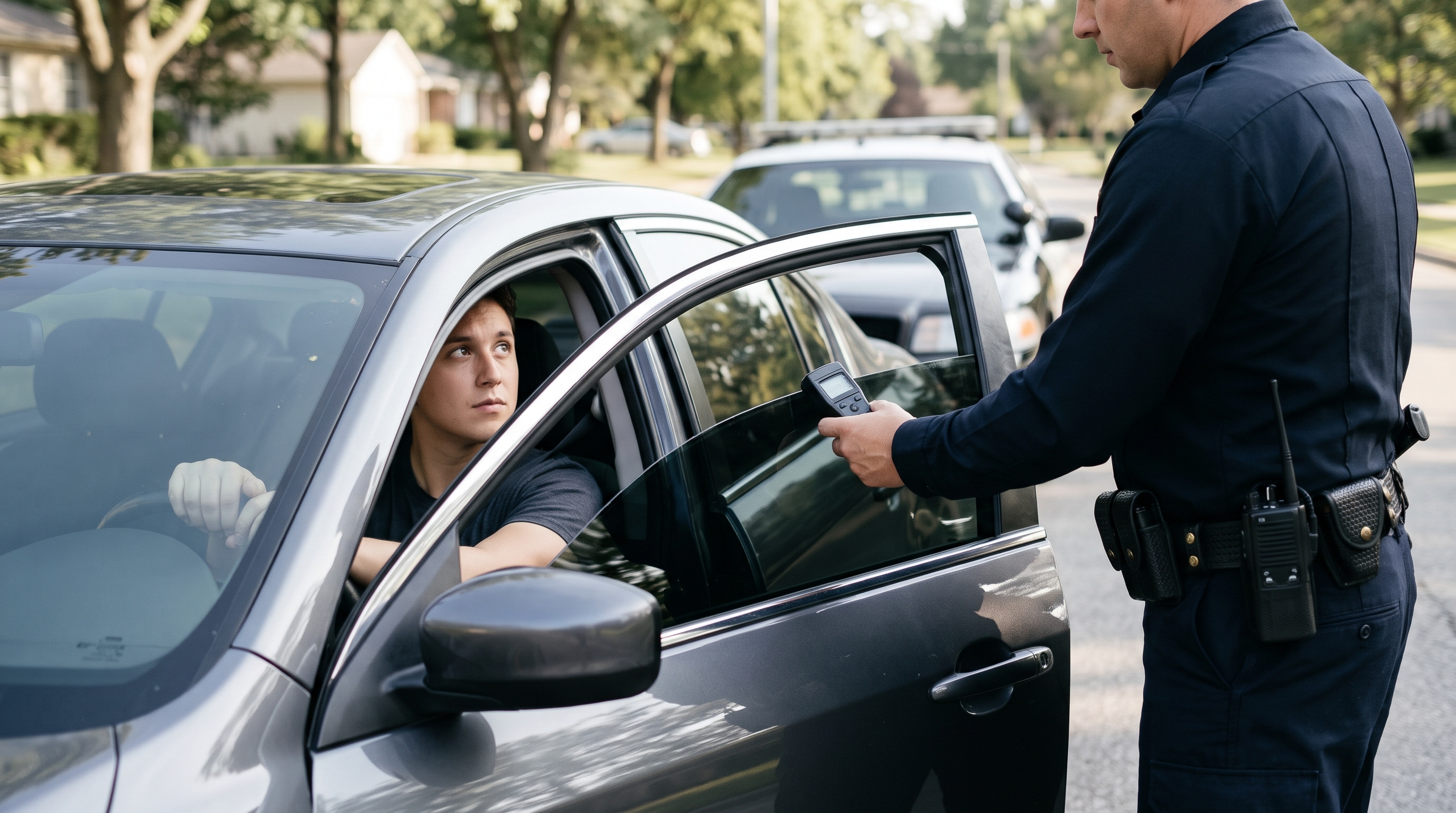
Can police pull you over just for window tint? The short answer
In most states, yes. If an officer reasonably suspects that your windows are darker than state law allows, that alone is enough to stop the car. The officer doesn't need to see you speeding or running a light first.
There are exceptions. Virginia bans stops for tint alone, and some states don't apply their tint law to cars registered elsewhere.
What decides whether a tint stop is legal:
- Reasonable suspicion: The officer must have a specific reason to think the tint breaks the law, such as not being able to see into the car.
- Your state's law: Many states treat tint as a primary offense, but a few, like Virginia, have made it secondary.
- Where the car is registered: Some state tint laws only cover vehicles registered in that state.
- The windows involved: Dark front side windows and windshields draw the most stops.
The legal standard: reasonable suspicion
Every traffic stop is a "seizure" under the Fourth Amendment, so police need reasonable suspicion that a law is being broken. For tint, courts usually accept an officer's estimate that the windows look substantially darker than the legal limit. The Sixth Circuit has held that an officer who is familiar with the state's tint law and estimates the car is tinted well below it has enough to make the stop.
The officer doesn't need to know the exact percentage before pulling you over. That's what the tint meter is for once the car is stopped.
Pretext stops are legal too
Many drivers suspect that tint is just an excuse to look for something else, and sometimes it is. Under Whren v. United States (1996), the Supreme Court held that a stop is valid if there's an objective traffic violation, whatever the officer's real motive. If your tint is illegal, the stop is lawful even if the officer was more interested in something else.
How tint stops work in different states
The rules on when officers can stop you vary more than most people realize:
| State | Can Police Stop for Tint Alone? | Key Detail |
|---|---|---|
| Virginia | No | Officers may not stop a car for a tint violation, and evidence from such a stop is inadmissible, even with consent (Va. Code § 46.2-1052) |
| Michigan | Yes, for Michigan-registered cars | The tint law doesn't apply to vehicles registered in another state (MCL 257.709) |
| Tennessee | Yes | A reasonable belief that the tint is illegal allows police to detain the car for a field test; refusing the test is a Class C misdemeanor (Tenn. Code § 55-9-107) |
Virginia made the change in a 2020 special session. Tint is still illegal there, but it's an "add-on" violation, so you can only be cited for it after being stopped for something else. Enforcement can also swing locally. Dearborn, Michigan, issued more than 800 tint tickets in about two months during one crackdown.
Check your state's limits on our 50-State Chart before assuming you're safe.
What usually triggers a tint stop
Based on court cases and what drivers report, these are the most common triggers:
- Front side windows the officer can't see through. Most states set their strictest limits on the windows next to the driver.
- A tinted windshield below the AS-1 line or the shade band. It's easy to spot from an oncoming car.
- Other issues on top of the tint, such as a missing plate, a broken light, or expired tags.
- Very dark film on a car that otherwise stands out. Many drivers on r/WindowTint say the car itself matters as much as the shade.
Lighting plays a part too. One driver said he was stopped for legal tint because overcast weather made it look darker than it was.
What happens during the stop
Most tint stops follow the same pattern. The officer asks for your license and registration, explains the reason for the stop, and may measure the glass with a tint meter. You may be asked to lower or raise the window so the meter can be placed on it.
The result depends on the state and the reading:
- A fix-it ticket, where the citation is dismissed once you remove the illegal film
- A fine, often around $100 for a first ticket and over $200 for a second, according to FindLaw
- Nothing, if the meter shows the tint is legal
If you have a medical exemption, hand it over with your license. It won't prevent the stop, but it should end the tint question. Our guide on getting a medical window tint exemption explains how it works in each state.
How to avoid a tint stop
The surest way is to stay within your state's limits and be able to prove it:
- Choose a legal shade for each window. Remember that factory glass already blocks some light, so the final reading is darker than the film's rating.
- Have the shop meter the finished windows and write the reading on your invoice.
- Keep the receipt and any compliance sticker. Tennessee, for example, requires installers to supply both.
- Skip the dark windshield unless your state or a medical exemption allows it.
- Keep the rest of the car in order, since a broken light plus dark tint makes you an easy stop.
If you already have illegal tint, removing it usually costs less than repeated tickets. See our window tint cost guide for removal prices.
Frequently asked questions
Can I get pulled over for having tinted windows?
Only if the officer reasonably suspects the tint is illegal, and only in states that allow tint as a primary stop. Legal tint is not a valid reason to stop you, although an officer can still misjudge it from outside the car.
Do cops actually care about tints?
It depends on the state, the department, and how dark the windows are. Some departments run crackdowns, while drivers in other areas report years without a tint stop. Officers care most about front windows they can't see through, because it hides who's inside.
Why can cops have tinted windows but I can't?
Most state tint laws exempt law enforcement vehicles. Virginia's law, for example, does not apply to them, and Florida's exempts undercover and K-9 vehicles.
Can a cop make you roll up your windows to check tint?
An officer can ask you to position the window so a tint meter can measure it, and in some states you're required to cooperate. In Tennessee, refusing the field test is a Class C misdemeanor.
This article is general information, not legal advice. Tint laws and stop rules change, so check your state's current statutes or talk to a local attorney if you've been cited.
Sources
- Whren v. United States, 517 U.S. 806 (1996), Justia
- Sixth Circuit opinion on a Tennessee tint stop, FindLaw
- Virginia Code § 46.2-1052
- Tennessee Code § 55-9-107, Justia
- Michigan's Window Tinting Laws, Monroe County Lawyers
- Dearborn police crack down on illegal tints, Yahoo News
- Window Tint Laws: The Basics, FindLaw
- Do you find cops will pull over cars with tinted windows?, r/WindowTint
Need a Verified Window Tint Pro in Your City?
Avoid non-compliant film and costly citations. Search our nationwide directory of licensed, highly-rated automotive window tint specialists with verified customer reviews and warranty-backed installations.
Find Tint Shops Near You →